

Cold weather can make a healthy lithium golf cart battery appear weak, unresponsive, or completely dead. In many cases, the real cause is low-temperature protection inside the Battery Management System, or BMS. When the battery gets too cold, the BMS may temporarily limit charging, discharging, or both to protect the cells from damage. Once the pack warms back into its approved temperature range, normal operation often returns. Modern hydrocell batteries use intelligent battery management to help monitor voltage, current, temperature, and cell balance.
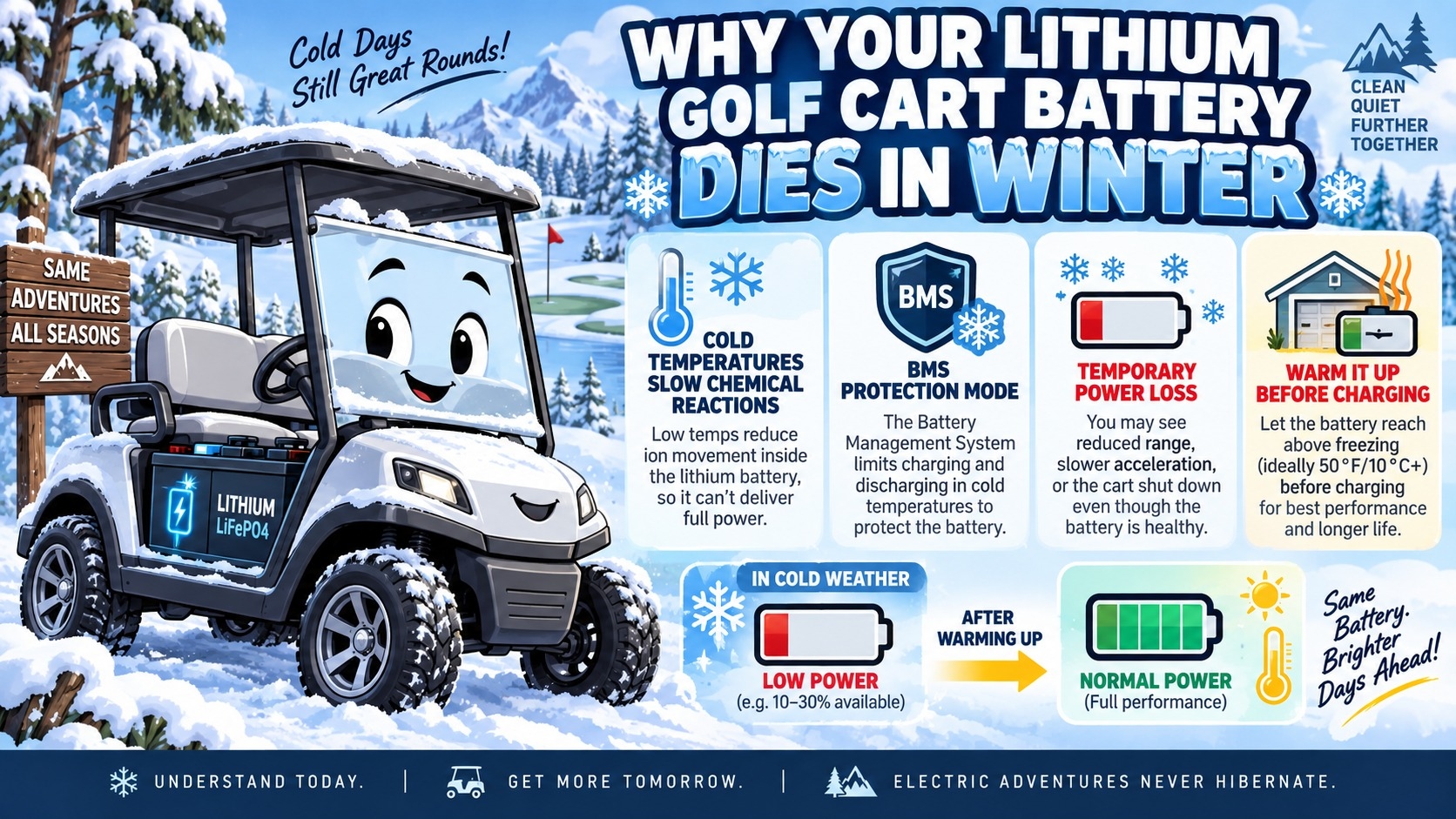
Why Cold Weather Affects Lithium Batteries
Lithium batteries depend on chemical reactions and ion movement inside each cell. As temperature drops, those reactions slow down.
This affects:
Available power
Charging speed
Voltage under load
Usable capacity
Battery response
A battery that works normally in warm weather may feel much weaker during a cold morning even when its state of charge has not changed dramatically.
Slow Chemical Reactions
At low temperatures, lithium ions move more slowly through the electrolyte.
This increases internal resistance and makes it harder for the battery to deliver current efficiently.
The result can be:
Slower acceleration
Reduced hill-climbing power
Temporary voltage sag
Shorter apparent range
This performance loss can improve again after the battery warms.
Temporary winter performance loss does not automatically mean the battery has lost permanent capacity. Always check battery temperature before assuming the pack has failed.
BMS Protection Mode
The BMS is the battery’s internal control system.
It continuously monitors conditions such as:
Cell voltage
Battery temperature
Charge current
Discharge current
Cell balance
If temperature falls outside the safe operating range, the BMS can temporarily shut down charging or output.
Why the BMS Blocks Charging in the Cold
Charging a LiFePO4 battery at very low temperature can cause lithium plating inside the cells.
Lithium plating can lead to:
Permanent capacity loss
Higher internal resistance
Reduced cycle life
Possible internal short-circuit risk
For this reason, many standard LiFePO4 systems prevent charging around or below 0°C unless the battery includes an approved heating system.
A battery refusing to charge in freezing weather may be protecting itself correctly. The cut-off function is a safety feature, not necessarily a fault.
Temporary Power Loss
Some golf cart owners report that their lithium battery suddenly shows little or no output after sitting outside overnight.
This can happen when the BMS enters a low-temperature or low-voltage protection state.
The battery may appear completely dead because:
The output circuit is temporarily disabled
The charger cannot start at low temperature
The pack voltage sags under cold load
The BMS is waiting for recovery conditions
Does Cold Weather Permanently Damage Lithium Batteries?
Cold storage alone does not necessarily damage a LiFePO4 battery if the temperature remains within the manufacturer’s allowed storage range.
The greater risk is charging the battery while it is too cold.
Discharging at low temperature is usually less damaging than low-temperature charging, although available power and capacity may still be reduced.
Typical LiFePO4 Winter Temperature Behavior
| Condition | Typical Behavior |
|---|---|
| Above 10°C (50°F) | Normal operation in most applications |
| 0°C to 10°C (32°F to 50°F) | Charging may slow; performance can decline |
| Around 0°C (32°F) | Many standard packs begin blocking charge |
| Below 0°C | Charging may be disabled by BMS |
| Around -20°C (-4°F) | Many packs approach their lower discharge limit |
These are general planning ranges only. Always follow the temperature limits for the specific battery model.
How to Fix a Lithium Golf Cart Battery That Seems Dead in Winter
1. Let the Battery Warm Up
Move the golf cart or battery into a warmer environment if possible.
Allow the battery to warm gradually until it is above the BMS recovery temperature.
Do not use open flames, uncontrolled heat guns, or other aggressive heating methods.
2. Reconnect the Charger After Warming
Once the battery is warm enough, connect the approved lithium charger.
The BMS may automatically wake and allow charging again.
3. Check the State of Charge
Cold weather can also make a partially discharged battery reach its low-voltage protection threshold sooner under load.
Once the pack is warm, check its state of charge and recharge if necessary.
If warming the battery does not restore output, do not bypass the BMS. Check the charger, connections, fuse, pack voltage, and any BMS fault indicators before further troubleshooting.
Store the Battery Properly
Proper winter storage can prevent many cold-weather problems.
For long storage periods:
Store the battery in a clean, dry place
Avoid extreme cold when practical
Maintain the manufacturer-recommended storage state of charge
Inspect periodically
Keep terminals protected from corrosion and accidental shorting
LiFePO4 batteries have relatively low self-discharge, but they should still be checked periodically during extended storage.
Should You Disconnect the Battery During Winter Storage?
Disconnecting the battery can help reduce parasitic loads from the golf cart.
Even when the cart is switched off, accessories or controllers may continue drawing a small amount of current.
Over weeks or months, this can gradually discharge the pack and potentially trigger low-voltage protection.
Follow the cart and battery manufacturer’s recommended storage procedure before disconnecting.
Why Parasitic Draw Matters
Common parasitic loads can include:
GPS units
USB chargers
Dash displays
Controllers
Audio systems
Lighting accessories
A small continuous draw can become significant over a long winter storage period.
Consider a Self-Heating Lithium Battery
For golf carts used regularly in cold climates, a self-heating battery can be a useful upgrade.
A heated lithium battery can use charger power or an internal heating system to bring the cells into a safe charging range before normal charging begins.
This can make winter charging more convenient.
| Feature | Standard LiFePO4 | Self-Heating LiFePO4 |
|---|---|---|
| Cold Charging | Usually blocked near freezing | Battery may warm before charging |
| Winter Convenience | May require manual warming | More automatic |
| Complexity | Lower | Higher |
| Best Use | Mild climates | Frequent cold-weather operation |
Can You Leave a Lithium Golf Cart Battery Outside in Winter?
It depends on the manufacturer’s storage limits and local temperatures.
A battery may tolerate cold storage better than cold charging, but prolonged exposure to extreme cold can still reduce performance and complicate charging.
Whenever possible, keeping the battery in a more moderate environment can improve winter reliability.
Why Range Drops in Winter
Golf cart range can drop in cold weather because:
Internal resistance rises
Voltage sags more under load
Available capacity temporarily decreases
Cold tires increase rolling resistance
Heaters or accessories may consume extra energy
Range usually improves again as temperature rises.
How to Prevent Winter Battery Problems
Keep the battery adequately charged before cold weather.
Avoid charging below the approved temperature.
Store the battery within manufacturer limits.
Disconnect parasitic loads during long storage.
Use the correct lithium charger.
Allow the pack to warm before charging.
Consider a self-heating battery in severe climates.
Do not bypass BMS protection.
The most important habit is simple: do not force charge into a LiFePO4 battery when it is below its approved charging temperature.
Do Hydrocell Batteries Have a BMS Protection Mode?
Yes. hydrocell batteries use modern Battery Management Systems to supervise battery operation and provide multiple protection functions in supported models.
These protections can include:
Overvoltage protection
Undervoltage protection
Overcurrent protection
Short-circuit protection
High-temperature protection
Low-temperature protection
Cell balancing
How Hydrocell BMS Protection Helps in Winter
When a Hydrocell battery detects temperature outside its approved operating range, the BMS can restrict charging or discharging according to the battery design.
This helps protect the cells from damage that might otherwise occur during cold-weather use.
Once temperature returns to the recovery range, the battery can resume normal operation according to its programmed logic.
If a hydrocell batteries system enters protection mode, allow the battery to return to its approved temperature range instead of bypassing the BMS.
How BMS Protection Changes the Ownership Experience
Without an intelligent BMS, owners would need to monitor battery temperature, voltage, and current manually.
Modern BMS technology automates much of that work.
| BMS Function | Ownership Benefit |
|---|---|
| Low-Temperature Cut-Off | Protects cells from unsafe cold charging |
| Overvoltage Protection | Helps prevent overcharging |
| Undervoltage Protection | Helps prevent excessive discharge |
| Overcurrent Protection | Protects against excessive current demand |
| Cell Balancing | Supports more consistent pack performance |
When a “Dead” Battery May Actually Need Service
Not every winter no-start condition is caused by temperature protection.
Further diagnosis may be needed if:
The battery remains inactive after warming
The charger shows an error
The pack voltage is abnormally low
Connections are loose or corroded
The BMS repeatedly trips under normal conditions
The battery has physical damage
In those situations, contact the battery manufacturer or a qualified service technician.
Conclusion
A lithium golf cart battery that appears dead in winter is often not permanently damaged.
Cold temperatures slow the chemical reactions inside LiFePO4 cells and increase internal resistance, which can temporarily reduce power and range.
More importantly, the BMS may intentionally block charging or output when the battery becomes too cold. This protection helps prevent lithium plating and other forms of permanent damage.
The best response is to let the battery warm gradually, use the correct charger, maintain an appropriate storage state of charge, and disconnect unnecessary parasitic loads during long winter storage.
For owners who use their golf carts frequently in freezing conditions, a compatible self-heating lithium battery can make winter charging easier.
hydrocell batteries use intelligent BMS technology that can include low-temperature protection along with overvoltage, undervoltage, overcurrent, short-circuit, temperature, and cell-balancing functions.
Instead of treating winter protection as a malfunction, understand it as a safeguard designed to protect battery life, safety, and long-term performance.