

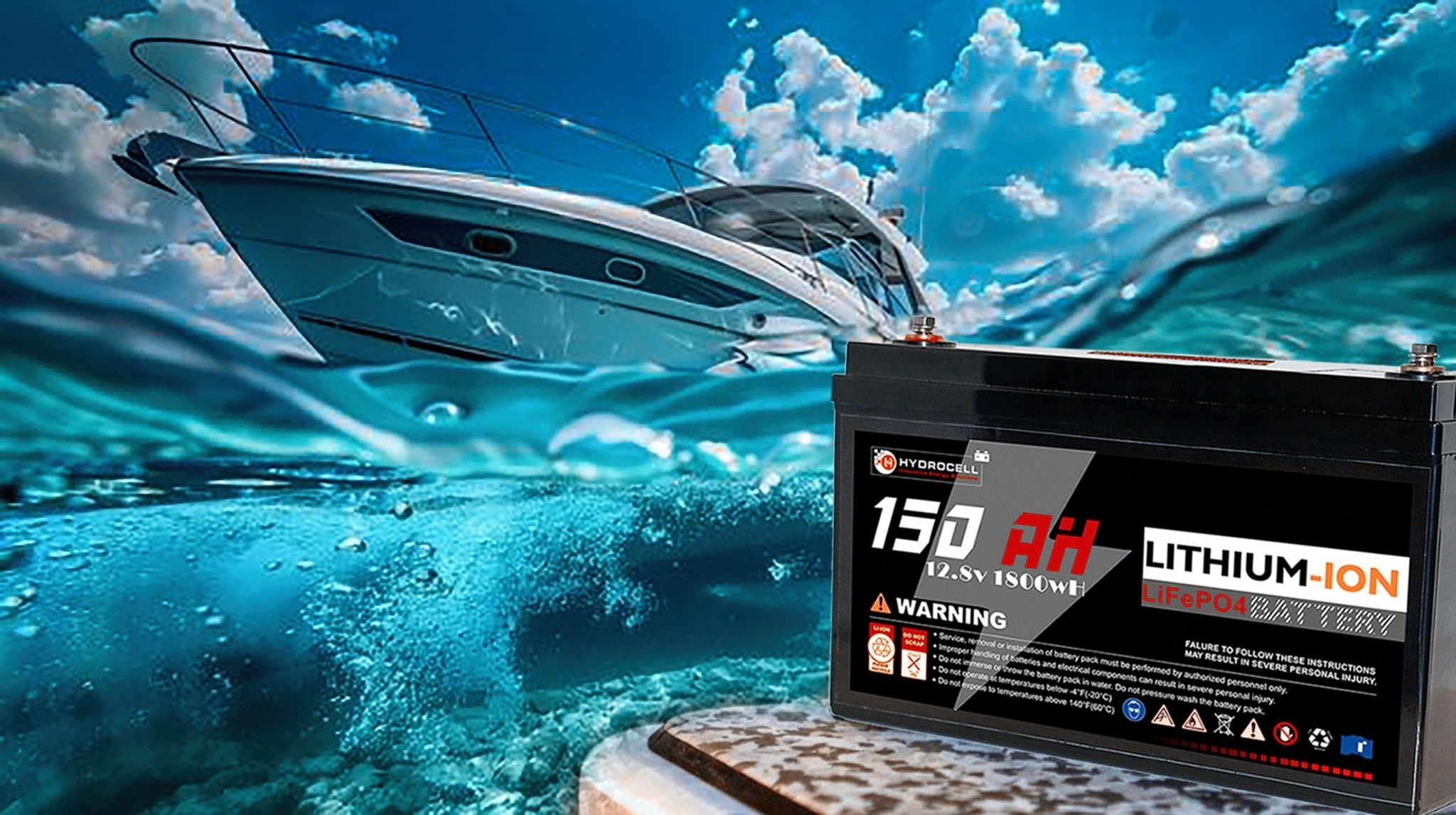
Choosing the right marine battery affects vessel weight, runtime, charging time, reliability, and long-term operating cost. Compared with traditional flooded or sealed lead-acid batteries, Hydrocell Marine Batteries use Lithium Iron Phosphate technology designed for deep-cycle marine applications such as trolling motors, onboard electronics, auxiliary power systems, and other sustained electrical loads.
Why Battery Choice Matters on a Boat
A marine battery does much more than start an engine. On many modern boats, the battery system must support trolling motors, navigation equipment, fish finders, pumps, lighting, communication equipment, refrigerators, inverters, and other onboard electrical loads.
These applications often require sustained power for hours rather than a short starting burst. This is why deep-cycle performance is so important.
A battery that is too heavy, charges too slowly, or loses voltage quickly under load can limit how long a boat stays on the water.
Key Advantages of Hydrocell Marine Batteries
| Feature | Hydrocell LiFePO4 | Typical Lead-Acid Alternative |
|---|---|---|
| Weight | Significantly lighter | Much heavier for similar usable energy |
| Cycle Life | About 3,000–5,000 cycles on representative models | Generally much lower |
| Charging | Fast charging supported | Typically slower |
| Maintenance | No routine watering | Flooded batteries require water checks |
| Deep-Cycle Use | Well suited to repeated discharge | Depends on battery design and depth of discharge |
| Self-Discharge | Low | Generally higher |
1. Lightweight Design
Weight matters on every boat. Extra battery mass can affect acceleration, handling, fuel consumption, draft, and how easily the vessel gets on plane.
Lithium iron phosphate batteries can deliver substantial energy at much lower weight than comparable lead-acid systems.
For example, Hydrocell's HC-R12100 12.8V 100Ah LiFePO4 marine battery is listed at approximately 11 kg while storing 1280Wh of energy.
Hydrocell also notes that LiFePO4 marine batteries can weigh roughly 50% to 70% less than equivalent lead-acid batteries in many applications.
Reducing battery weight can free up payload capacity for passengers, fishing equipment, fuel, food, safety gear, or other onboard equipment while also helping improve overall vessel balance.
2. Extended Lifespan
Long cycle life is one of the strongest reasons marine owners move from lead-acid to lithium.
Hydrocell's representative 100Ah LiFePO4 battery is rated for approximately 3,000 to 5,000 cycles. Hydrocell's FAQ also states that its LiFePO4 batteries are typically rated to deliver around 3,500 cycles at 100% depth of discharge under specified conditions.
By comparison, traditional lead-acid batteries normally provide far fewer deep cycles, particularly when they are frequently discharged below about 50% state of charge.
Hydrocell states that LiFePO4 batteries can last many times longer than lead-acid batteries when used for the same application.
3. Deep-Cycle Power for Marine Loads
Marine applications often require a battery to deliver power steadily over long periods.
Examples include:
Trolling motors
Fish finders
GPS and navigation systems
Marine lighting
Bilge and water pumps
Radios and communications
Refrigerators
Inverters
Onboard entertainment
A deep-cycle Hydrocell Marine Battery is designed for sustained discharge rather than only providing a short engine-starting burst.
This makes LiFePO4 particularly useful for fishing boats, recreational vessels, yachts, and other applications where electrical systems may operate for many hours between charging opportunities.
4. Rapid Charging
Charging time directly affects how quickly a boat can get back on the water.
Hydrocell's HC-R12100 specification lists a standard charge time of approximately 4 to 5 hours and a fast-charge time of approximately 2 to 3 hours when the appropriate charger and charging conditions are used.
LiFePO4 chemistry also has high charging efficiency and does not require the same long absorption stage associated with traditional flooded lead-acid batteries.
This can be particularly valuable for boat owners who use their vessel frequently or have limited time between trips.
A shorter charging window can reduce downtime between fishing trips, recreational outings, or commercial operating periods. Always use the charger specified or approved for the battery.
5. Low Routine Maintenance
Flooded lead-acid batteries require periodic maintenance. Owners may need to inspect electrolyte levels, add distilled water, remove corrosion, and ensure the battery remains fully charged to limit sulfation.
LiFePO4 batteries eliminate routine watering and generally require less day-to-day maintenance.
Owners should still inspect terminals, wiring, mounting hardware, charge status, and battery condition regularly, but the overall maintenance burden is significantly lower.
6. Low Self-Discharge
Low self-discharge is especially useful for seasonal marine applications.
Hydrocell lists a self-discharge rate below 5% per month for its HC-R12100 battery. This means the battery can retain its stored energy relatively well when the boat is not being used.
Proper storage procedures should still be followed, particularly during long winter storage periods.
What Is Special About a Marine Battery?
A marine battery is designed to operate in an environment very different from a car or stationary battery installation.
Marine batteries may need to handle vibration, changing temperatures, moisture, repeated discharge, long operating periods, and demanding electrical loads.
There are generally three broad marine battery roles:
| Battery Type | Main Purpose |
|---|---|
| Starting Battery | Provides a short, high-current burst to crank an engine. |
| Deep-Cycle Battery | Supplies steady power for trolling motors and onboard electronics. |
| Dual-Purpose Battery | Attempts to combine starting and deep-cycle capabilities. |
For trolling motors and house loads, deep-cycle performance is usually more important than maximum starting current.
Why LiFePO4 Is Well Suited to Marine Use
LiFePO4 differs from other lithium-ion chemistries because it emphasizes cycle life, thermal stability, and durability rather than maximum possible energy density.
For marine owners, that combination offers several practical benefits:
More usable energy per unit of weight
Long cycle life
Stable voltage during discharge
Low routine maintenance
Faster charging
Good deep-cycle capability
These characteristics make LiFePO4 an attractive replacement for traditional deep-cycle lead-acid batteries.
How Long Can Hydrocell Marine Batteries Last?
Hydrocell states that LiFePO4 marine batteries can provide approximately 3,000 to 5,000 or more cycles depending on the specific model, depth of discharge, charging conditions, temperature, and operating environment.
In calendar terms, a properly used LiFePO4 marine battery may provide many years of service. Hydrocell's marine battery guidance notes that LiFePO4 marine batteries can commonly reach approximately 8 to 15 years or more under suitable conditions.
Actual service life depends heavily on how the battery is charged and stored.
What About Hydrocell's Warranty?
Warranty coverage should be checked for the exact battery model and market before purchase.
Hydrocell's current general warranty policy states a five-year limited warranty for standard lithium batteries. Some individual product pages may advertise different guarantee terms, so buyers should confirm the applicable warranty with the dealer or Hydrocell before ordering.
Do not rely only on a headline warranty number. Confirm the coverage period, registration requirements, cycle-life exclusions, approved charger requirements, and conditions that may void coverage.
Where Can Hydrocell Marine Batteries Be Used?
Hydrocell Marine Batteries can support a range of marine electrical applications.
| Marine Application | Typical Battery Role |
|---|---|
| Fishing Boats | Trolling motors, fish finders, lighting |
| Recreational Boats | House loads and auxiliary electronics |
| Yachts | Navigation, lighting, appliances, auxiliary energy |
| Electric Propulsion | Traction energy for compatible electric marine systems |
| Commercial Boats | Auxiliary loads and deep-cycle power |
| Offshore Equipment | Backup and auxiliary electrical supply |
What Should Buyers Check Before Switching to Lithium?
Confirm the required battery voltage.
Calculate the required amp-hour capacity.
Check maximum continuous and peak current requirements.
Measure the available battery compartment.
Confirm terminal configuration.
Verify charger compatibility.
Check wiring and fuse requirements.
Use proper hold-down hardware.
Review charging and storage temperature limits.
Confirm the warranty for the exact model.
Final Thoughts
Marine battery buyers choose Hydrocell because LiFePO4 technology addresses several of the biggest disadvantages associated with traditional lead-acid batteries: weight, limited cycle life, slower charging, and routine maintenance.
A representative Hydrocell 12.8V 100Ah marine battery weighs approximately 11 kg, stores 1280Wh, supports roughly 3,000 to 5,000 cycles, and can recharge in approximately 2 to 3 hours under fast-charge conditions.
For trolling motors, onboard electronics, auxiliary marine power, and other deep-cycle applications, Hydrocell Marine Batteries offer a lightweight, long-life alternative for boat owners who want dependable energy without the maintenance burden of traditional flooded lead-acid batteries.