
Battery storage has become one of the fastest-growing parts of the global power system. Falling battery costs, expanding renewable generation, and growing demand for flexible electricity have made lithium-ion batteries the leading technology for modern energy storage. Within the lithium-ion category, Lithium Iron Phosphate, or LFP, now dominates stationary storage installations because it combines relatively low cost, long cycle life, and strong thermal stability.
The energy storage market expanded rapidly during 2025 and entered 2026 with strong momentum.
According to the International Energy Agency, global battery storage additions reached approximately 108 GW in 2025, around 40% more than the previous year. Battery storage is now one of the fastest-growing power technologies worldwide.
| Market Indicator | 2026 Market Context |
|---|---|
| New Battery Storage Capacity | About 108 GW added globally in 2025 |
| Annual Growth | Approximately 40% |
| LFP Share of Stationary Storage | About 90% |
| Utility-Scale Share | Roughly four-fifths of new capacity |
| Main Growth Drivers | Solar, wind, grid flexibility, backup power, peak shifting |
Lithium Iron Phosphate has become the dominant lithium chemistry for stationary storage because energy storage systems prioritize different characteristics from electric vehicles.
A stationary battery does not need to be extremely light or compact. Instead, buyers usually prioritize:
Cycle life
Safety
Cost per kWh
Thermal stability
Reliable daily cycling
Low maintenance
LFP performs particularly well in these areas.
Lithium-ion storage systems offer high round-trip efficiency, which means most of the electricity used to charge the battery can later be recovered when the battery discharges.
This makes lithium-ion particularly attractive for:
Solar energy storage
Commercial peak shaving
Time-of-use energy shifting
Grid frequency control
Backup power
Renewable energy smoothing
High efficiency improves the economics of storing electricity every day.
Battery costs have fallen substantially over the past decade as manufacturing capacity, supply chains, and cell production have expanded.
This has made lithium-ion batteries competitive in residential, commercial, and utility-scale projects.
Large-scale production has also helped reduce the cost of battery management systems, inverters, modules, and complete containerized storage solutions.
Utility-scale batteries currently represent the majority of global battery storage additions.
These systems are increasingly being used for energy shifting rather than only short-term grid balancing.
For example, a solar farm may generate large amounts of electricity around midday. A battery can store this electricity and discharge it during the evening, when solar output falls and demand often rises.
This use case has become one of the most important reasons battery storage is expanding so quickly.
Most battery storage projects historically focused on one- or two-hour discharge durations.
That is changing.
The average duration of newly commissioned utility-scale battery projects reached about three hours in 2025, up from around two hours in 2023, while more projects are being designed for four hours or longer.
This reflects increasing demand for batteries to shift larger volumes of renewable electricity across the day.
NMC, or Nickel Manganese Cobalt, remains important in applications where maximum energy density matters, especially electric vehicles.
For stationary storage, however, LFP has become much more popular.
| Feature | LFP | NMC |
|---|---|---|
| Energy Density | Moderate | Higher |
| Cycle Life | Generally longer | Good |
| Thermal Stability | Very strong | Requires careful thermal management |
| Raw Material Cost | Generally lower | Generally higher |
| Stationary Storage Use | Dominant | Much smaller share |
Because stationary storage is less sensitive to weight and size, LFP's lower cost and long cycle life often matter more than NMC's higher energy density.
Lithium-ion is extremely competitive for short- and medium-duration storage, but it becomes more expensive when systems need to discharge continuously for many hours or several days.
This has encouraged development of alternative technologies such as:
Flow batteries
Compressed-air energy storage
Thermal storage
Pumped hydro
Hydrogen storage
These technologies may become more important for long-duration storage, while lithium-ion continues to dominate shorter-duration applications.
Sodium-ion batteries are one of the most closely watched emerging battery technologies.
They use sodium instead of lithium as the primary charge carrier and can reduce dependence on some critical battery minerals.
Potential advantages include:
Abundant raw materials
Potentially lower material costs
Good low-temperature performance
Reduced dependence on lithium supply
However, sodium-ion batteries generally offer lower energy density than established lithium-ion systems.
The broader lithium-ion battery market remains in a strong expansion phase.
Global battery demand exceeded 1.5 TWh in 2025 and grew by more than 35% year over year. Battery storage became one of the major sources of demand growth alongside electric vehicles.
EVs and stationary energy storage together now represent roughly 90% of the lithium-ion battery market.
This means battery manufacturers are increasingly serving two major industries:
Electric transportation
Stationary energy storage
Both sectors continue to expand rapidly.
The lithium-ion battery supply chain remains heavily concentrated in China.
China dominates global production of LFP cathode materials, battery cells, anode materials, and several other parts of the battery supply chain.
This scale helps keep costs low, but it also creates supply-chain concentration risks for other regions.
Battery manufacturers in North America, Europe, Korea, Japan, and Southeast Asia are expanding local production, but China remains the clear manufacturing leader.
Electricity systems are adding increasing amounts of variable renewable energy.
Solar and wind generation fluctuate depending on weather and time of day. Battery storage helps manage that variability by storing electricity when production is high and releasing it when demand rises.
Modern lithium-ion batteries can support:
Renewable integration
Peak shifting
Frequency regulation
Grid resilience
Residential backup
Commercial demand management
Despite its market leadership, lithium-ion technology still has limitations.
| Challenge | Why It Matters |
|---|---|
| Thermal Runaway | Requires careful BMS, cooling, monitoring, and fire protection |
| Long-Duration Cost | Very long discharge times require large battery capacity |
| Supply Concentration | Manufacturing is heavily concentrated in China |
| Battery Aging | Capacity gradually declines with cycling and calendar time |
| Raw Materials | Large-scale deployment increases demand for lithium, graphite, copper, and other materials |
In the near term, lithium-ion is very likely to remain the leading battery technology for stationary storage because it already benefits from enormous manufacturing scale, established supply chains, mature safety systems, and declining costs.
Alternative technologies would need to compete not only on technical performance but also against lithium-ion's global manufacturing ecosystem.
Long-duration technologies may capture specialized applications, but lithium-ion remains extremely competitive for projects in the two- to four-hour range and increasingly beyond.
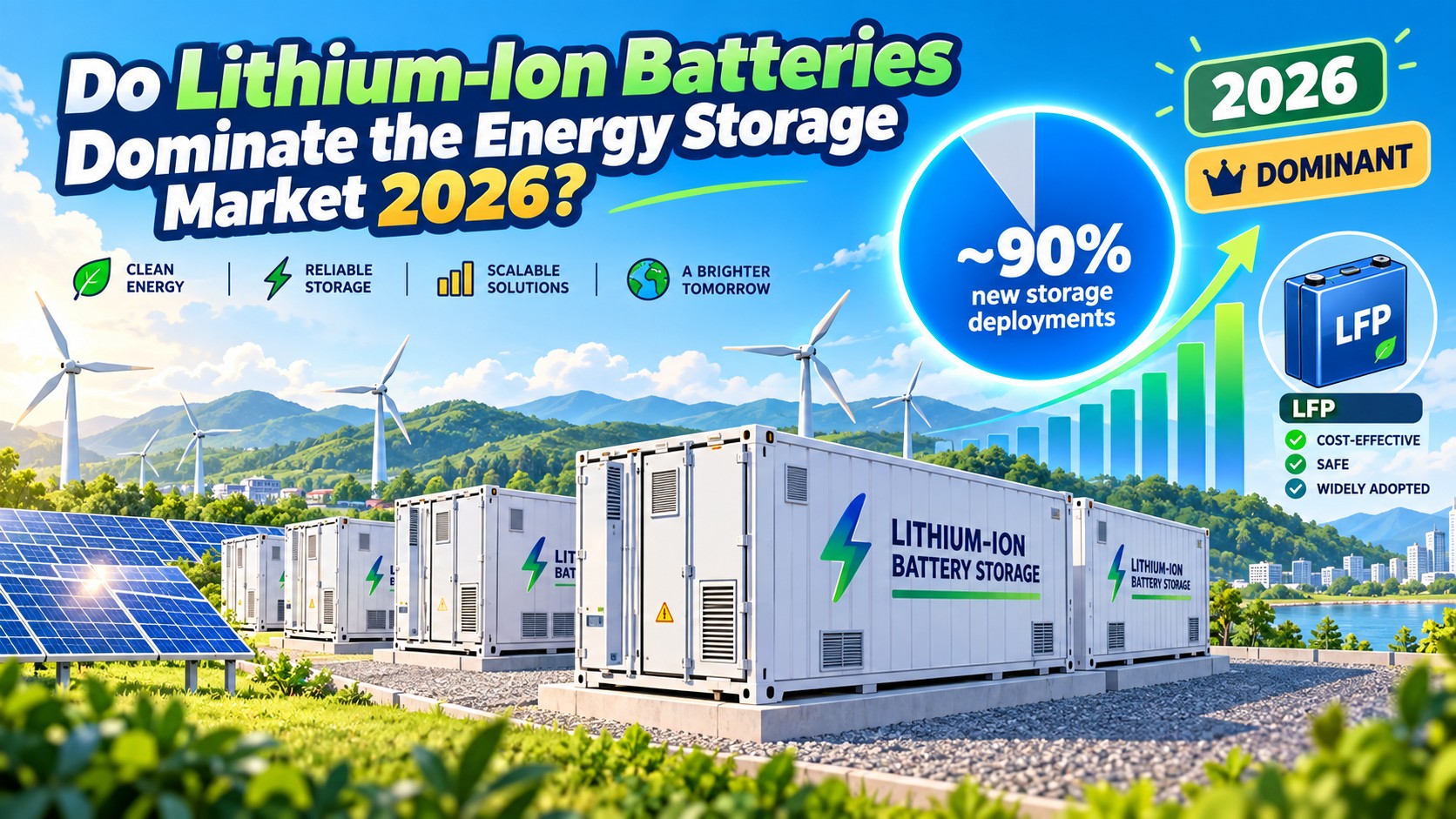
So, do lithium-ion batteries dominate the energy storage market in 2026? Yes. Lithium-ion remains the clear leader, with LFP accounting for around 90% of global stationary battery storage deployments in 2025.
The market is being driven by falling costs, renewable energy integration, high efficiency, fast response, and rapidly expanding utility-scale installations.
LFP has overtaken NMC in stationary storage because it provides long cycle life, strong thermal stability, and lower cost where maximum energy density is not the highest priority.
Emerging technologies such as sodium-ion, flow batteries, and other long-duration solutions will continue to grow, but lithium-ion batteries remain the dominant energy storage technology entering 2026.