

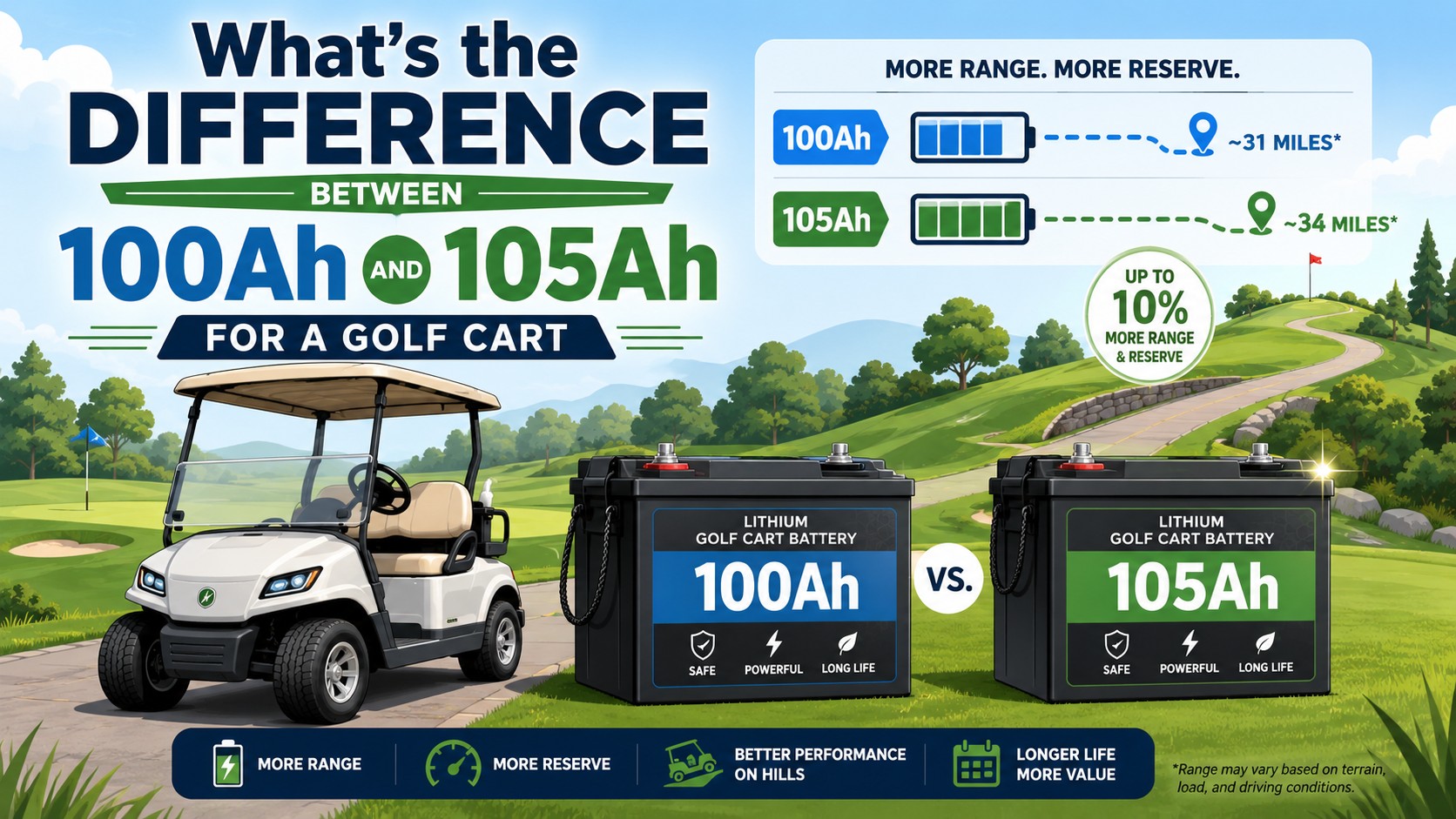
A 105Ah golf cart battery stores about 5% more energy than a 100Ah battery, providing a modest range advantage under similar conditions.
The primary difference between a 100Ah and 105Ah golf cart battery is capacity. A 105Ah battery can theoretically store 5% more energy, which may provide a few additional miles of range. However, hill-climbing performance and acceleration depend more on continuous discharge current, peak output, voltage stability and the battery management system than on the extra 5Ah alone.
Amp-hours, abbreviated as Ah, describe how much electrical charge a battery can deliver over time. In simple terms, a higher Ah rating generally means the battery can run the golf cart longer before it needs to be recharged.
For example, a 100Ah battery could theoretically provide 10 amps for 10 hours. A 105Ah battery could theoretically provide the same 10-amp load for 10.5 hours. Real golf carts draw changing amounts of current, so actual runtime depends on speed, terrain, passenger weight and driving behavior.
At the same nominal voltage, increasing capacity from 100Ah to 105Ah represents a 5% increase. With a nominal 48V system, the approximate stored-energy difference is:
48V 100Ah: approximately 4.8kWh
48V 105Ah: approximately 5.04kWh
Difference: approximately 0.24kWh, or 5%
This additional energy can extend driving range, but it does not automatically make the golf cart 5% faster or 5% more powerful.
| Comparison | 100Ah Battery | 105Ah Battery |
|---|---|---|
| Rated capacity | 100 amp-hours | 105 amp-hours |
| Capacity difference | Baseline | Approximately 5% more |
| Approximate energy at 48V | 4.8kWh | 5.04kWh |
| Potential range | Suitable for regular course and community use | May provide a few additional miles under similar conditions |
| Charging time | Slightly shorter with the same charger | Slightly longer with the same charger |
| Physical size | Depends on the manufacturer | May be similar or slightly larger |
| Purchase price | Usually slightly lower | May cost slightly more |
| Best for | Stock carts and moderate daily use | Longer routes, heavier loads or additional accessories |
A 105Ah battery may provide approximately 2 to 5 additional miles compared with a similar 100Ah battery, but this should be treated as a general estimate rather than a guaranteed result.
Because the capacity increase is only 5%, a golf cart that travels 40 miles with a 100Ah battery might theoretically travel around 42 miles with a comparable 105Ah battery. The actual difference may be smaller or larger depending on operating conditions.
Factors that reduce golf cart range include:
Steep hills and repeated climbing
Heavy passenger or cargo loads
Lift kits and oversized tires
High travel speeds
Frequent acceleration and braking
Cold or extremely hot temperatures
Low tire pressure
Light bars, sound systems and other accessories
Battery age and state of health
Not necessarily. Capacity and power output are related but different specifications. Amp-hour capacity primarily affects runtime, while power under load depends on voltage and the amount of current the battery can safely deliver.
A 105Ah battery may feel stronger than a 100Ah battery if it also has a higher continuous discharge rating, higher peak-current rating or better control of voltage sag. However, the extra 5Ah by itself does not create dramatically more torque.
When comparing golf cart batteries, examine these specifications:
Continuous discharge current: Current the battery can provide during normal driving
Peak discharge current: Short-term output for acceleration or climbing
BMS current limit: The point at which the protection system disconnects output
Voltage sag: How much battery voltage drops under a heavy load
Cell quality: Affects stability, efficiency and cycle life
Cable and terminal rating: Determines whether current can flow safely
Some budget 100Ah batteries may be limited to around 100A of continuous output, while certain 105Ah systems are built for substantially higher current. In such a comparison, the higher-output battery may provide better hill performance, but the improvement comes from its discharge capability rather than its capacity rating alone.
For hilly terrain, continuous and peak discharge ratings are more important than choosing between 100Ah and 105Ah. A golf cart climbing a steep slope requires high current from the battery, especially when carrying several passengers.
If a battery has an undersized BMS or a low continuous-current limit, the cart may accelerate slowly, experience noticeable voltage drop or enter protection mode. A battery with stronger current delivery can maintain more stable performance.
Before choosing a battery for hills, check the motor controller’s expected current, cart voltage, tire size, passenger capacity and manufacturer recommendations.
A 100Ah battery is often sufficient for a stock two-seat golf cart used on relatively flat terrain. It can be a practical choice for playing 18 holes, making short community trips or handling routine transportation.
Consider a 100Ah model when:
Your cart has standard tires and suspension
You usually carry one or two passengers
Your regular route is mostly flat
You drive moderate distances each day
You do not operate several high-power accessories
You want to control the initial purchase cost
A quality 100Ah battery with strong current delivery may perform better than a poorly designed 105Ah battery. Build quality and BMS specifications should remain part of the decision.
A 105Ah battery may be worthwhile when you regularly use more energy or want a small reserve at the end of the day. The 5% capacity increase is modest, but it can reduce range anxiety when the price difference is small.
Consider 105Ah when:
You operate a four-seat or six-seat cart
You frequently carry passengers or cargo
Your route includes hills or uneven terrain
Your cart has oversized tires or a lift kit
You use upgraded lights, speakers or other accessories
You want slightly more range between charges
Always confirm that the battery fits the tray and is compatible with the cart’s charger, controller and electrical system.
For many golf carts, yes. A 48V 100Ah LiFePO4 battery provides approximately 4.8kWh of nominal energy, which is enough for normal recreational and transportation use in many applications.
Whether it is enough for your cart depends on how far you drive, how much weight you carry and how demanding the terrain is. A lightly loaded stock cart on flat pavement will normally use less energy than a lifted cart carrying four passengers uphill.
To estimate your requirements, follow these steps:
Measure your normal daily distance. Include the return trip and unexpected detours.
Review passenger and cargo weight. Heavier loads increase energy consumption.
Consider the terrain. Frequent hills require more current and energy.
List electrical accessories. Lighting, audio equipment and USB devices consume battery power.
Add a reserve margin. Avoid selecting a battery that must be completely discharged every day.
Check discharge ratings. Confirm that continuous and peak current meet the cart’s requirements.
Verify dimensions. Make sure the battery fits securely in the existing compartment.
Confirm charger compatibility. Use the correct LiFePO4 charging profile and voltage.
Yes. The HC-G48100 is a 48V 100Ah LiFePO4 golf cart battery designed as a replacement option for compatible golf carts.
The battery stores approximately 4.8kWh of energy and provides a continuous discharge rating of 105A. It is designed for compatibility with popular golf cart brands, subject to model, compartment and electrical-system requirements.
Choosing a hydrocell battery can also reduce maintenance compared with a traditional flooded lead-acid battery. LiFePO4 batteries do not require regular watering or electrolyte testing.
The HC-G48100 can be considered for standard golf carts that need a practical balance of capacity, charging time and everyday performance.
Before ordering a hydrocell battery, verify the required voltage, battery-compartment dimensions, terminal positions, charger compatibility and controller current.
The upgrade can be worthwhile when the 105Ah battery costs only slightly more and all other specifications are equal. The additional capacity provides a small range reserve and may reduce how deeply the battery is discharged during normal use.
However, a 105Ah battery is not automatically the better product. A high-quality 100Ah battery with dependable cells, a strong BMS and good technical support may offer better long-term value than a lower-quality 105Ah unit.
Compare the complete specification sheet, warranty, charger, expected cycle life, service support and installation requirements before making a final decision.
The difference between a 100Ah and 105Ah golf cart battery is mainly a 5% increase in capacity. A 105Ah battery may provide a few additional miles of range, but the exact improvement depends on vehicle weight, terrain, speed, tires, weather and accessories.
For a standard cart on flat terrain, 100Ah is usually a practical capacity. A 105Ah battery may be better for heavier carts, longer routes or users who want additional reserve energy.
For hill climbing and acceleration, focus on continuous current, peak output and voltage stability rather than Ah alone. The best choice is the battery that matches the complete electrical and operating requirements of your golf cart.